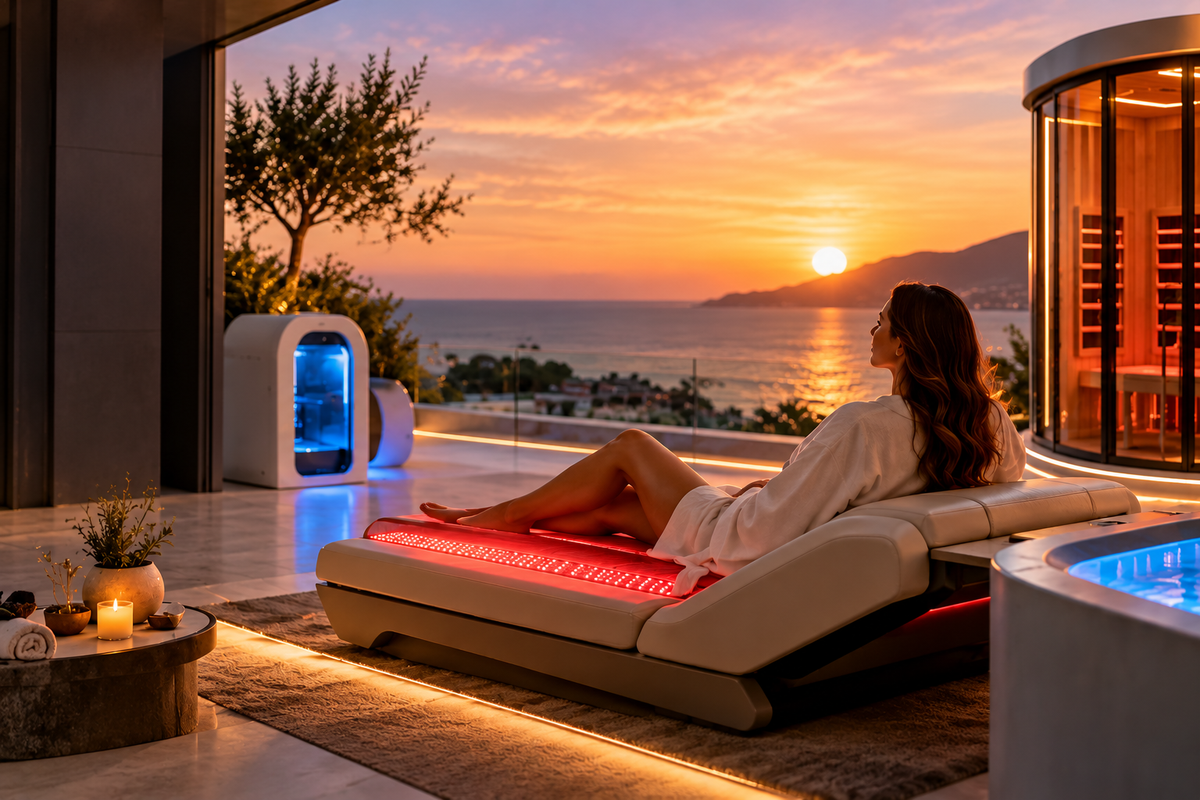

PEMF or Red Light: Choosing Equipment for Your Recovery Room
A refined recovery room should do more than look exceptional. It should meet the demands of the person using it - whether that means arriving home after a transcontinental workweek, restoring tired legs after training, or creating a calmer transition into sleep. In the conversation around PEMF therapy versus red light, the harder part usually isn't deciding which modality appeals to you — it's translating that decision into the right equipment for your actual room, budget, and household. If you're still weighing which modality fits your personal recovery style, our guide on red light versus PEMF covers that in depth. This guide picks up from there: how to actually plan for and choose equipment once you know the direction you want to go.
Both technologies can earn a place in an elevated wellness sanctuary. Yet they work differently, feel different during a session, and fit different recovery rituals. Red light therapy is often selected for its restorative glow, ease of use, and skin-forward appeal. PEMF is typically chosen for a quieter, more deeply relaxing experience centered on recovery readiness and whole-body restoration.
| Modality | Session experience | Typical space needed | Price range | Best-fit setting |
| --- | --- | --- | --- | --- |
| Red light therapy | Exposed skin, standing or reclining near a light source; eye protection often required | A wall or corner with clearance to stand or lie at the right distance; beds need dedicated floor space | Roughly $400 for a compact panel up to $5,000+ for large panels or full-body beds | Home gym, dressing room, or a performance-focused recovery suite |
| PEMF therapy | Fully clothed, lying down; passive and quiet | A flat surface (mat, bed, or lounge) in a low-traffic, calm area | Entry mats often run $500-$3,000; premium multi-modality systems can run well into five figures | Bedroom, office, or a quiet evening wind-down space |
A Quick Refresher on How Each Works
Red light therapy uses red and near-infrared wavelengths (a process called photobiomodulation) directed at the body from a panel or bed. PEMF uses pulsed electromagnetic fields instead of light, delivered through a mat, lounge, or full-body system. For the full breakdown of how each mechanism works and which one tends to suit which goals, see Red Light Versus PEMF: Which Fits Your Recovery? — the table above already covers what matters most for planning your space.
What Red Light Therapy Does Best
Red light therapy is especially compelling for clients who want one modality to support both performance and presentation. Premium panels and full-body beds can deliver broad, even coverage without requiring a complicated treatment protocol. For homeowners, the visual design can become part of the room itself.
Red light also integrates easily with an active schedule. A 10- to 20-minute session can fit before a shower, before a workout, or as part of a structured wind-down. Because it does not require physical exertion or a major time commitment, it is one of the more approachable technologies for a household with multiple users.
Its trade-off is simple: light-based treatment is directional. Positioning, distance, coverage area, wavelength selection, and session consistency all influence the experience. A small panel can be an excellent targeted tool, but it does not create the same whole-body ritual as a full-size bed or a carefully positioned multi-panel installation.
Where PEMF Therapy Fits Into Recovery
The scientific picture around PEMF is nuanced. Certain pulsed electromagnetic field applications have established medical uses under professional guidance, while consumer wellness systems vary substantially in field strength, pulse patterns, intended use, and supporting research. That variation is precisely why equipment quality and responsible guidance matter.
For many users, PEMF's strongest advantage is adherence. It asks very little of you. You lie down, breathe, and allow recovery time to become protected time. For executives and athletes alike, that can be the difference between owning a wellness device and actually using it four or five days per week.
PEMF also suits environments where visual calm is central to the design brief. A thoughtfully integrated mat, bed, or lounge can disappear into a bedroom, private training studio, treatment room, or hospitality spa. The result feels less like clinical equipment and more like an invitation to pause.
For serious athletes, the answer may be both. Red light and PEMF are not direct substitutes in every setting — they can work as complementary elements in a complete recovery suite alongside compression, massage infrared heat, and cold exposure. Once you know which modality — or both — fits your goals, the next question is how to actually fit it into your space.
Consider the Space, Not Just the Specification
The right equipment should respect the architecture of your life. A red light panel requires a location where you can stand or sit at the appropriate distance, while a full-body bed calls for dedicated floor space and thoughtful electrical planning. In a luxury residence, placement matters as much as performance. The equipment should feel intentional whether it lives in a gym, dressing room, primary suite, or private spa area.
PEMF systems have different considerations. A portable mat can work beautifully in a bedroom or office, while a larger recovery bed or lounge benefits from a dedicated wellness room. The visual language should align with the rest of the environment: clean lines, quiet materials, and a level of comfort that encourages repeat use. Flooring and nearby surfaces should hold up to regular cleaning, since both red light and PEMF equipment see frequent contact and, in red light's case, occasional perspiration. Ambient lighting that dims independently of the equipment helps the room shift between a bright, energizing session and a calmer evening one.
For commercial projects, the decision extends beyond the client experience. Durability matters most here: equipment that performs beautifully for a single household may not hold up to daily use by dozens of different guests, so look closely at materials and component quality rated for commercial duty cycles, not just residential specs. Cleanability is equally important; surfaces should tolerate the disinfecting protocols a spa or gym runs between every guest without degrading the finish. Room flow deserves early attention too — guests need a clear path in and out that doesn't cross wet-area traffic or create a bottleneck during peak hours, and staff need practical access to controls and service points without disrupting a session in progress. Power access should be confirmed with the property's engineering team well before equipment is ordered, particularly when a recovery suite is adding red light, PEMF, cold plunge, and sauna systems to the same electrical run. Manufacturer warranty coverage is worth reading closely for commercial work specifically, since many consumer warranties narrow or void under commercial use. Freight and installation coordination round things out: large panels, beds, and lounges often ship on pallets and may need freight elevator or loading dock access, with lead times that can extend for custom finishes. A beautiful wellness amenity loses its value if it is difficult to operate or awkwardly placed.
Safety and Sensible Expectations
Neither modality should be treated as a replacement for medical evaluation, rehabilitation, or prescribed care. If you have an implanted electronic device, are pregnant, have a known medical condition, take photosensitizing medication, or are managing an injury, consult a qualified clinician before beginning PEMF or red light therapy. Follow the specific device instructions, including eye protection guidance for red light equipment.
It is also wise to separate credible wellness support from dramatic marketing language. Better recovery habits can support how you feel and perform, but no premium device overrides inadequate sleep, poor nutrition, overtraining, or a schedule that leaves no room for restoration. The technology is most valuable when it reinforces disciplined basics.
A Better Standard for Your Recovery Ritual
At Luxe Vida Wellness, the most compelling wellness spaces are built around behavior, not novelty. The equipment should make recovery easier to protect, more enjoyable to repeat, and worthy of the standard you set everywhere else. When strength and serenity exist in harmony, the room becomes more than a collection of devices. It becomes the place where you return to yourself.
If you're still weighing which modality fits you personally, our full comparison — Red Light Versus PEMF: Which Fits Your Recovery? — walks through that decision in depth. Ready to bring red light, PEMF, or both into your space? Request a quote.