Longevity Market Trends 2026: Where Wellness Is Headed
The most revealing longevity market trends are not found in a single new device. They appear in the way high-performing households, hospitality brands, and developers are redesigning the spaces around daily recovery. Wellness is moving beyond an occasional appointment or a crowded home gym corner. It is becoming a private operating system for energy, sleep, training readiness, stress management, and the rituals that make sustained performance feel possible.
For premium buyers, the question is no longer, “Which wellness product should I buy?” It is, “What environment will support the way I want to live?” That distinction is reshaping demand for recovery technology, design-forward installations, and expert-led curation.
Longevity Market Trends 2026 by the Numbers
The demand behind private recovery spaces is measurable. The global wellness economy reached a record $6.8 trillion in 2024 and is forecast to approach $9.8 trillion by 2029, according to the Global Wellness Institute. Healthy aging sits near the center of that growth: up to 60% of consumers across major markets now rank it as a top or very important priority, according to McKinsey's Future of Wellness survey.
The fastest-moving segment is the one closest to this conversation. Wellness real estate reached $876 billion in 2025, growing 23% in a single year while global construction grew just 3%. It is forecast to pass $1 trillion in 2027 and reach $1.8 trillion by 2030. Buyers are not just purchasing wellness; they are building it into where they live, stay, and work.
Longevity Market Trends Are Becoming Environmental
The longevity category once leaned heavily on products that could be easily packaged: supplements, wearables, and app-based health programs. Those tools remain part of the conversation, but the premium market is expanding toward physical environments that make restorative habits easier to keep.
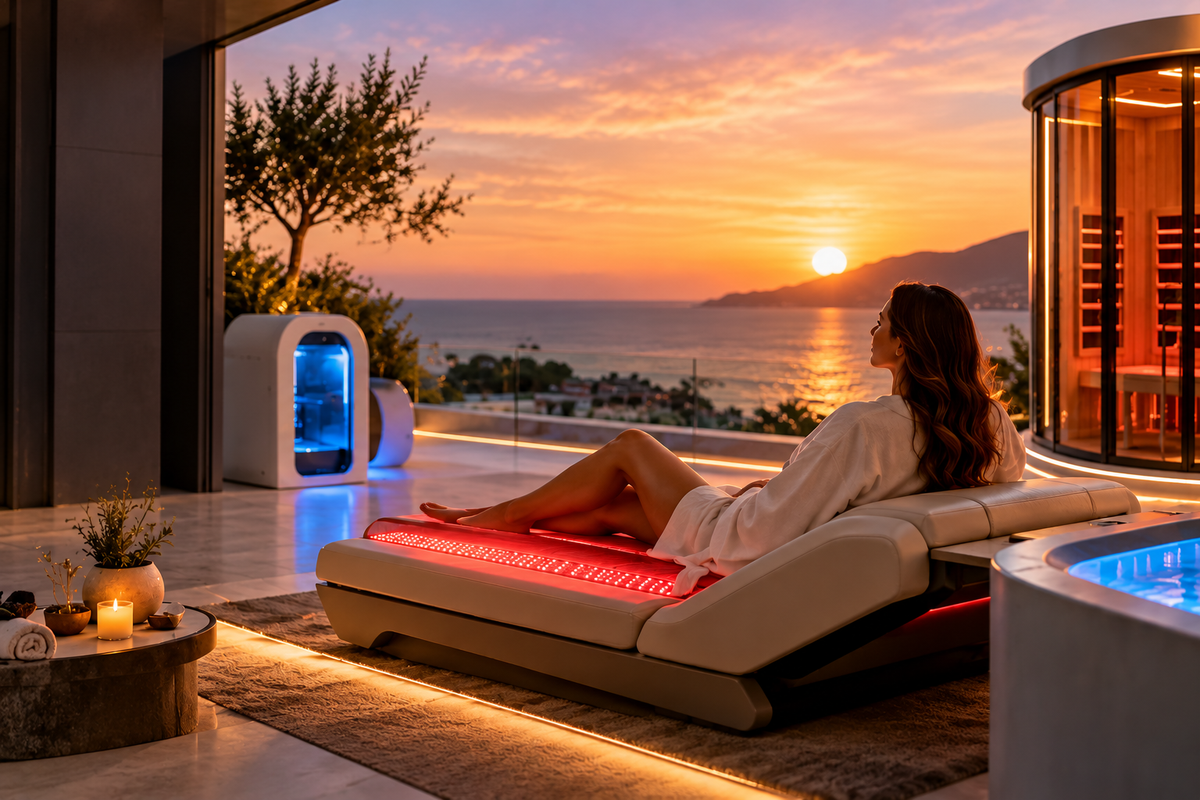
A home recovery suite can turn an intention into a repeatable ritual. A carefully specified sauna, cold water therapy setup, PEMF system, red light equipment, compression station, or massage chair removes the friction of travel, booking, and shared facilities. For an executive with a demanding schedule or an athlete with limited recovery windows, convenience is not a minor luxury. It is often the difference between a wellness plan that lasts two weeks and one that becomes part of the week.
This is why dedicated wellness rooms are gaining ground in high-end residences, boutique hospitality, and multifamily development. The strongest projects do not treat recovery equipment as an accessory. As any thoughtful home wellness room design shows, they consider electrical capacity, flooring, ventilation, moisture, acoustics, circulation, privacy, lighting, and visual continuity from the first planning conversation. The United States leads this shift, with a $254 billion wellness real estate market, the largest in the world.
Design Has Become Part of the Value Proposition
Early home wellness setups often looked improvised: a collection of disconnected devices competing for square footage. The market is maturing. Buyers increasingly expect equipment to perform at a high level and belong visually in a refined interior.
That expectation has practical consequences. A wellness space is more likely to be used when it feels calm, organized, and intuitively functional. Storage for towels and accessories, appropriate drainage, flattering low-glare lighting, and room to move between modalities matter as much as the equipment itself. Luxury in every ray or every cold immersion is not only about the device. It is about the complete sensory experience surrounding it.
For architects and designers, this creates a more sophisticated brief. They are not simply allocating room for a product. They are helping create an amenity that supports a client’s daily standard of living and can strengthen the identity of an entire property.
The Shift From Single Modality to Recovery Systems
Another defining market movement is the rise of the integrated recovery system. Consumers are becoming more informed about the fact that different modalities may serve different preferences and moments: heat for relaxation and a deliberate wind-down, cold plunges for a bracing contrast, compression for post-training comfort, massage for a restorative pause, PEMF for recovery as a quieter ritual, and infrared cardio equipment for movement without abandoning a considered wellness environment. At the top of the market, buyers are also investing in longevity capsules that combine several modalities in a single footprint, hyperbaric chambers for pressurized oxygen sessions, and whole-body cryotherapy chambers once reserved for elite training facilities.
This does not mean every room requires every category. More equipment is not automatically better. A compact residence may benefit from two or three exceptional pieces that match the owner’s actual routine, while a destination spa may need a broader circuit designed for guest flow and turnover. The right specification depends on available space, household needs, training habits, desired privacy, budget, and the level of operational support required.
The key trend is intentionality. Premium buyers are stepping away from piecemeal shopping and toward a curated approach in which each element has a role. The result is less clutter, fewer neglected purchases, and a more coherent recovery ritual.
Convenience Is the Premium Feature
The most advanced technology is of limited value if it is inconvenient to access. This is one reason private wellness environments have become so compelling. They let users recover before the workday, decompress after travel, or reset after training without adjusting their schedule around a facility.
There is also a privacy dimension. Many affluent consumers value the ability to use wellness technology without a crowded locker room, membership limitations, or the performative atmosphere of a public setting. Their preferred environment is discreet, beautifully maintained, and available on their terms.
That preference extends to hospitality. Hotels, resorts, private clubs, and luxury residential communities are using wellness amenities to create a more memorable stay or residence. Guests are willing to go out of their way for it: 56% of U.S. buyers of in-person wellness services say they would travel two hours or more for a wellness retreat. A well-designed recovery offering can differentiate a property, particularly for guests and residents who see healthspan support as a non-negotiable part of travel and everyday life.
What the Market Is Asking of Premium Providers
As the category becomes more complex, buyers are placing greater value on confidence before and after purchase. A wellness suite can involve significant freight, power requirements, plumbing considerations, room measurements, manufacturer lead times, and installation coordination. The sale is no longer finished when a checkout button is pressed.
This is where service becomes a defining market trend. Clients want clear specifications, credible warranty coverage, responsive support, financing options where appropriate, delivery planning, and a single informed partner who can coordinate the moving parts. Commercial clients may also need volume pricing, custom sourcing, documentation, and guidance that respects construction schedules and design intent.
At Luxe Vida Wellness, this consultative model recognizes a simple reality: a premium wellness purchase should feel considered from the first conversation through final placement. White-glove coordination is not an embellishment. For many large or highly customized projects, it is essential to protecting the investment.
Evidence, Education, and More Discerning Buyers
The longevity market is also becoming more skeptical in a productive way. Consumers are exposed to bold claims daily, and sophisticated buyers increasingly ask better questions. What is the intended use? What does the research actually support? How does a modality fit within training, nutrition, sleep, and medical care? What can reasonably be expected, and over what timeline? McKinsey's research reflects the same shift: the most engaged wellness consumers increasingly look for solutions that are science-backed and demonstrably effective, and they define value by results rather than novelty.
This is a healthy shift. Premium wellness technology should be presented with clarity, not miracle language. Individual experiences vary, and equipment is not a substitute for medical diagnosis or treatment. People with health conditions, implanted devices, pregnancy, or medication considerations should consult a qualified clinician before beginning a new protocol.
Education should also address practical ownership. A beautiful recovery environment needs a realistic maintenance plan. Water-based equipment requires attentive care. Upholstered and high-touch surfaces need regular cleaning. Filters, electrical connections, ventilation, and manufacturer guidelines deserve ongoing attention. Reliable performance is built through thoughtful ownership, not just an exceptional initial installation.
The New Luxury Is Consistency
For years, wellness marketing often treated longevity as a distant promise. The more compelling direction is closer to home: how does a person feel when their calendar is full, their body is taxed, and their attention is fragmented? Can their environment make recovery more available, more pleasurable, and easier to sustain?
That is where the premium market is headed. It is favoring systems over isolated purchases, spaces over scattered devices, and consistent rituals over occasional intensity. The most successful wellness environments will balance advanced technology with simplicity. They will feel elevated enough to be aspirational, yet practical enough to be used on an ordinary Tuesday.
For buyers and project teams, the opportunity is to build around real behavior rather than novelty. Choose the modalities that fit the people who will use them, give the space the infrastructure it deserves, and protect the experience with capable delivery and ongoing care. Strength and serenity can exist in harmony when recovery is designed as a standard, not treated as an afterthought.
Recovery works best when it is designed as a standard, not treated as an afterthought. Explore our longevity and recovery collections, or speak with a Luxe Vida Wellness specialist to plan a space built around the way you live.