Commercial Sauna Buyer Review for Premium Spaces
A commercial sauna buyer review should begin long before a model is selected. For a private club, boutique fitness studio, day spa, or multifamily development, a sauna is not simply a heat amenity. It is part of the member and guest experience, the visual standard of the property, and the daily operating workload of the team responsible for it. A beautiful cabin that cannot sustain peak-hour use, meet local requirements, or be serviced efficiently will not feel luxurious for long.
The strongest commercial purchase is therefore not always the largest sauna or the one with the most dramatic specification sheet. It is the system that suits the traffic pattern, wet-area conditions, design intent, electrical capacity, and recovery experience your property intends to deliver.
Commercial Sauna Buyer Review: Start With the Experience
Before reviewing heaters, wood species, or control systems, define who will use the sauna and how often. A destination spa may need a generous, calm environment that supports longer dwell times and fits into a thermal circuit. A high-performance training facility may prioritize fast recovery turnover before and after sessions. A multifamily development needs an intuitive amenity that works reliably without a full-time spa attendant.
These distinctions affect nearly every buying decision. A sauna built for six people on paper may feel crowded once guests need room to enter, sit comfortably, and maintain a sense of privacy. Conversely, oversizing a sauna for a lightly used residents' lounge can increase construction, energy, and maintenance costs without improving the resident experience.
Consider the entire sequence around the cabin. Where do guests change? Is there a nearby shower, cool-down lounge, or cold plunge? Is the sauna visible from a fitness floor, or placed within a more private wellness suite? In premium environments, the transition matters as much as the heat. Strength and serenity should exist in harmony, from the first approach to the final recovery moment.
Capacity Is More Than a Seat Count
Commercial capacity should be measured against peak demand, not average attendance. Ask when the space is busiest and how long each guest is likely to stay. A hotel spa may see concentrated demand in the morning, after treatments, and late afternoon. An athletic club may experience a sharp rush after group classes. A residential project may have lower volume but higher expectations for privacy and condition.
A practical planning exercise is to estimate the number of users during the busiest 60 to 90 minutes, then determine whether the sauna can serve them without making guests wait uncomfortably. This does not mean every facility needs a large communal cabin. Two smaller, well-positioned saunas may sometimes create a better operational flow than one oversized room, particularly when different user groups need separation.
Bench layout deserves the same scrutiny. Multi-level seating allows guests to choose a more or less intense heat zone, while sufficient depth and back support improve comfort during longer sessions. Door swing, entry clearance, and the path to nearby showers should also be resolved early. These details determine whether a space feels thoughtfully designed or merely equipped.
Choose Traditional Heat or Infrared for the Right Reason
Traditional and infrared commercial saunas create distinctly different experiences. Traditional saunas heat the room and, depending on the heater and operating approach, can support the familiar ritual of water on stones. They are often the natural choice for spas, luxury clubs, and hospitality environments where atmosphere, heat intensity, and social ritual matter.
Infrared saunas use radiant heat directed toward the body and usually operate at lower ambient temperatures. They can be compelling for recovery-focused settings, private wellness suites, and facilities seeking a more approachable heat experience. Their lower room temperatures may also appeal to guests who are hesitant about a conventional sauna.
Neither format is automatically superior. Traditional heat generally requires more attention to room construction, ventilation, heater clearance, and electrical planning. Infrared cabins may offer a more compact installation path, but commercial suitability still depends on component quality, intended duty cycle, cleaning requirements, and manufacturer support. Do not select infrared solely because it seems easier, or traditional solely because it appears more prestigious. Select the modality that matches the ritual your guests expect.
The Cabin Must Be Built for Repetition
A commercial sauna experiences a different life than a private residential unit. Doors open frequently, surfaces are cleaned repeatedly, controls are used by many people, and humidity or nearby wet conditions can place continuous demands on materials. The cabin should be evaluated as a high-use interior, not as a decorative box.
Look closely at the quality of the interior wood, bench construction, fasteners, insulation, vapor management, and door hardware. The best material selection depends on the sauna type and project setting, but the standard is straightforward: surfaces should remain stable, comfortable, attractive, and serviceable through sustained use. Thoughtful joinery and replaceable wear components can protect the investment over time.
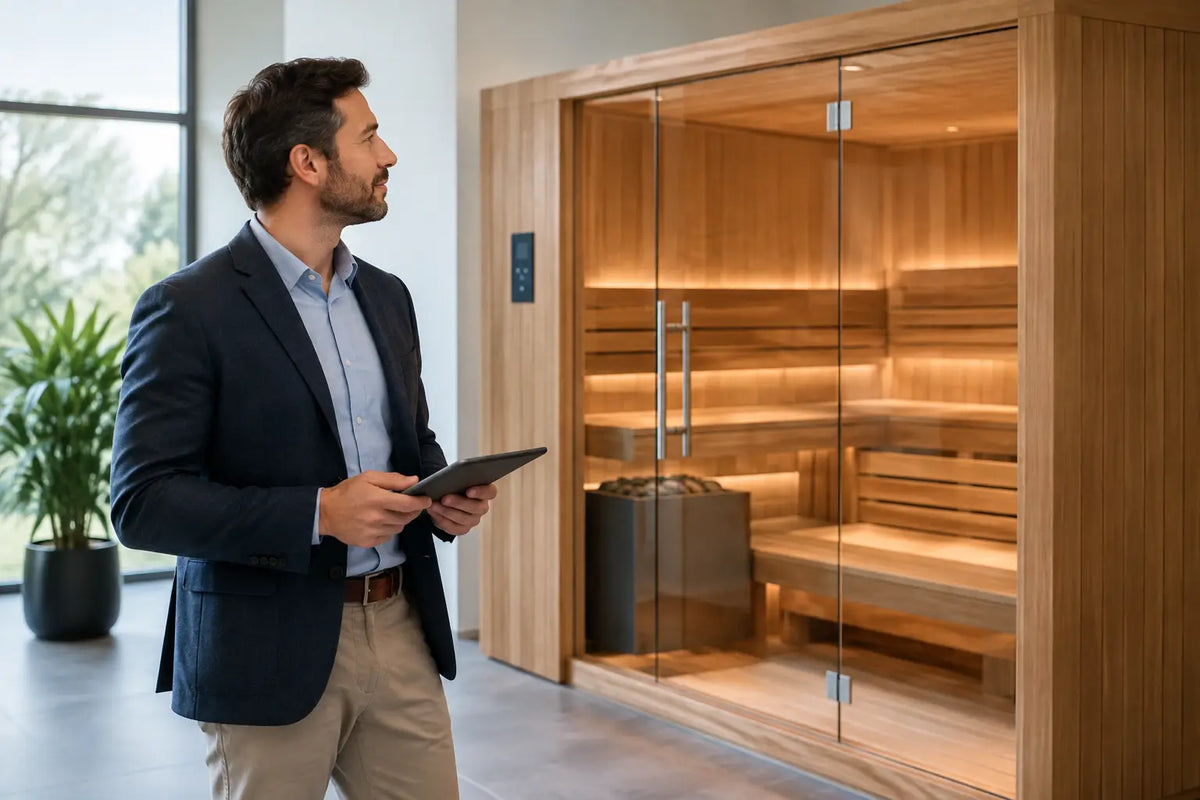
For design-led projects, exterior finishes also deserve early coordination. Glass fronts, custom cladding, integrated lighting, and adjacent stone or tile can create a striking wellness environment. Yet those features should never interfere with access panels, ventilation paths, safe clearances, or future service. Luxury is not a finish applied after the engineering is complete. It is the confidence that every visible detail and hidden system belongs together.
Heater Sizing and Recovery Time
Heater selection is where many commercial specifications become too simplistic. Heater output must be matched to the cabin volume, but room volume alone does not tell the whole story. Glass area, exterior walls, insulation values, ceiling height, climate conditions, and door traffic can all increase the effective heating load.
An undersized heater may eventually reach temperature during quiet periods, yet struggle to recover after repeated entries. That inconsistency is immediately noticeable to guests and can lead staff to extend operating hours or set temperatures aggressively, neither of which is an ideal solution. A correctly specified heater, paired with appropriate controls, delivers a more dependable guest experience and a more rational energy profile.
Commercial buyers should also ask about stone capacity, replacement parts, heater access, and the availability of qualified service support. A heater is the working heart of the sauna. Its long-term serviceability matters more than a minor upfront savings.
Controls Should Protect the Guest Experience
A commercial control system has two jobs: make operation simple and prevent misuse. Guests may need a limited, intuitive interface, while facility teams need secure access to scheduling, temperature limits, operating windows, and safety settings. Remote monitoring can be valuable for larger properties, but only if the staff has a clear process for responding to alerts and maintaining the system.
Automatic timers, lockout settings, and approved temperature limits should be specified according to local requirements and the intended operating model. If a sauna will be unattended for portions of the day, confirm what supervision, emergency procedures, and shutoff provisions are required. A premium amenity should feel effortless to the guest while giving the operator meaningful control behind the scenes.
Code, Ventilation, and Site Conditions Cannot Be Afterthoughts
Commercial sauna projects require early coordination among the equipment provider, architect or designer, general contractor, electrician, and local authorities having jurisdiction. Requirements vary by municipality and property type, so final decisions should always be verified locally. Electrical service, dedicated circuits, fire and life-safety provisions, drainage nearby, accessible routes, and appropriate clearances all need consideration before an order is finalized.
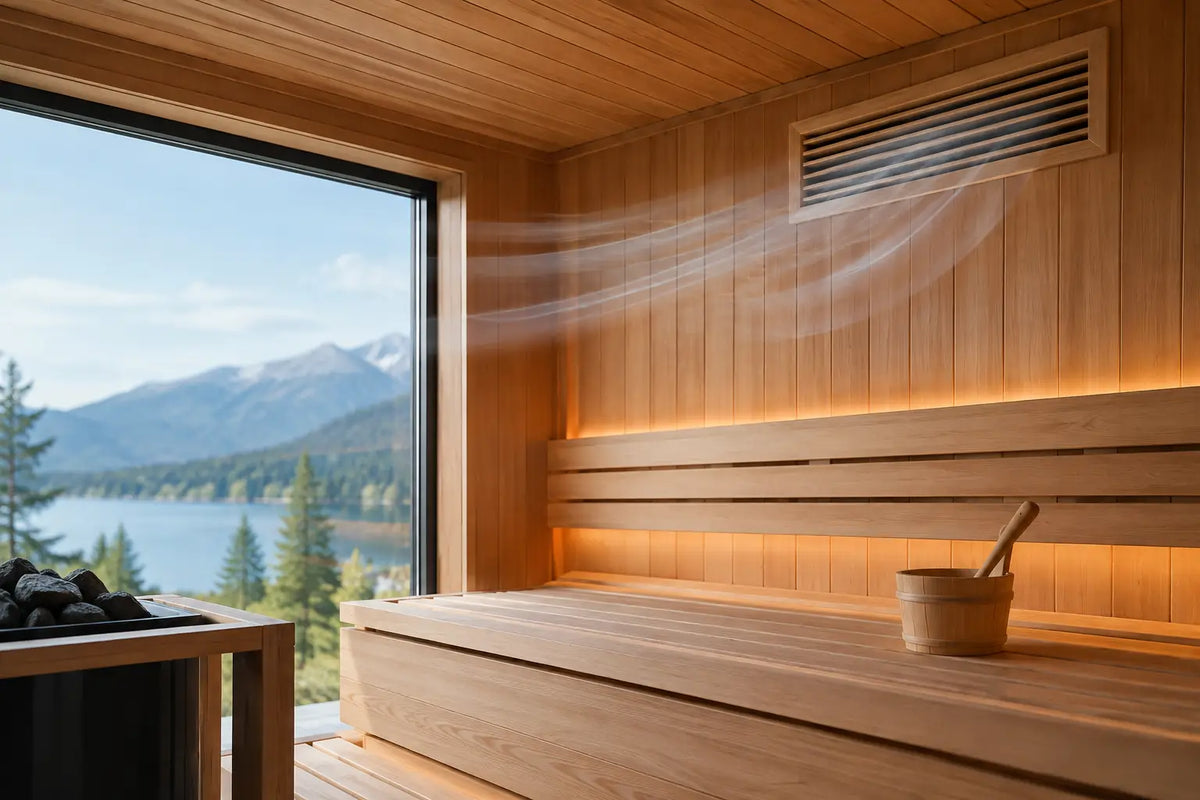
Ventilation is especially important. A sauna needs an intentional air path that supports comfort, material longevity, and reliable operation. Poor ventilation can make the room feel stale, contribute to excess moisture in surrounding construction, and complicate temperature performance. The solution is not a generic vent placement copied from another project. It should be designed around the sauna system, room layout, and building conditions.
For hospitality, spa, and development projects, there is also an operational question: who owns the daily care? Staff should have a documented routine for wiping surfaces, checking controls, inspecting door hardware, maintaining the heater area, and escalating issues before they become closures. Maintenance is part of the amenity plan, not a task to discover after opening day.
Evaluate the Supplier as Carefully as the Sauna
A commercial sauna is rarely a boxed-product transaction. It is a coordinated project with freight timing, site readiness, receiving requirements, installation sequencing, and warranty responsibilities. The right supplier should be able to discuss specifications in the context of your project, not simply repeat a catalog description.
Ask direct questions about lead times, delivery access, white-glove options, installation coordination, documentation, warranty coverage, and post-installation support. For custom work, establish who approves drawings, confirms field dimensions, and manages changes if conditions differ from the plan. A lower initial quote can become costly when these responsibilities are vague.
Luxe Vida Wellness approaches commercial wellness spaces as complete environments, helping project teams source and specify premium equipment that fits the property's goals, visual language, and operational reality. That perspective is especially valuable when a sauna will sit beside cold therapy, red light, fitness, treatment, or relaxation amenities.
Sauna Options to Review for Clubs, Studios, and Multifamily Spaces
If you are building a shortlist, these are good places to start. Each suits a different footprint and level of use, so confirm duty cycle, electrical requirements, and local code with our team before you specify.
Compact infrared: Wizzisaunas full spectrum infrared saunas come in one-, two-, and two-to-three-person formats, which suit studios, private suites, and smaller amenity rooms where space is limited.
Traditional cabin kits: Kohler saunas offer indoor and outdoor kit options for properties that want a classic Scandinavian heat experience with a refined, design-forward look.
Outdoor steam and barrel saunas: Our custom outdoor steam saunas are available in four-, six-, and eight-person sizes, and the Blisspod barrel saunas suit courtyards, rooftops, and resort-style grounds.
Not sure which format fits your space and traffic? Contact Luxe Vida Wellness for help matching a sauna to your project.
Make the Final Decision on Lifetime Value
The final commercial sauna buyer review should compare more than purchase price. Consider expected usage, electrical consumption, service access, cleaning demands, replacement components, warranty terms, construction complexity, and the revenue or retention value the amenity may create. A luxury hotel may justify a custom traditional sauna because it strengthens its spa identity. A high-end residential development may find that a refined, dependable infrared cabin better serves its available footprint and resident behavior.
The best sauna is the one guests return to because it feels exceptional every time they enter. Build around that standard, and the investment will support more than heat. It will create a recovery ritual people remember.
Ready to Find the Right Sauna for Your Space?
Whether you are planning a members' club, a boutique studio, a day spa, or a multifamily amenity, the right choice starts with a conversation about your space, your traffic, and your operating goals. Luxe Vida Wellness helps project teams specify and source premium saunas built for daily use.
Request a quote to start planning with our team, or compare your sauna options first.