
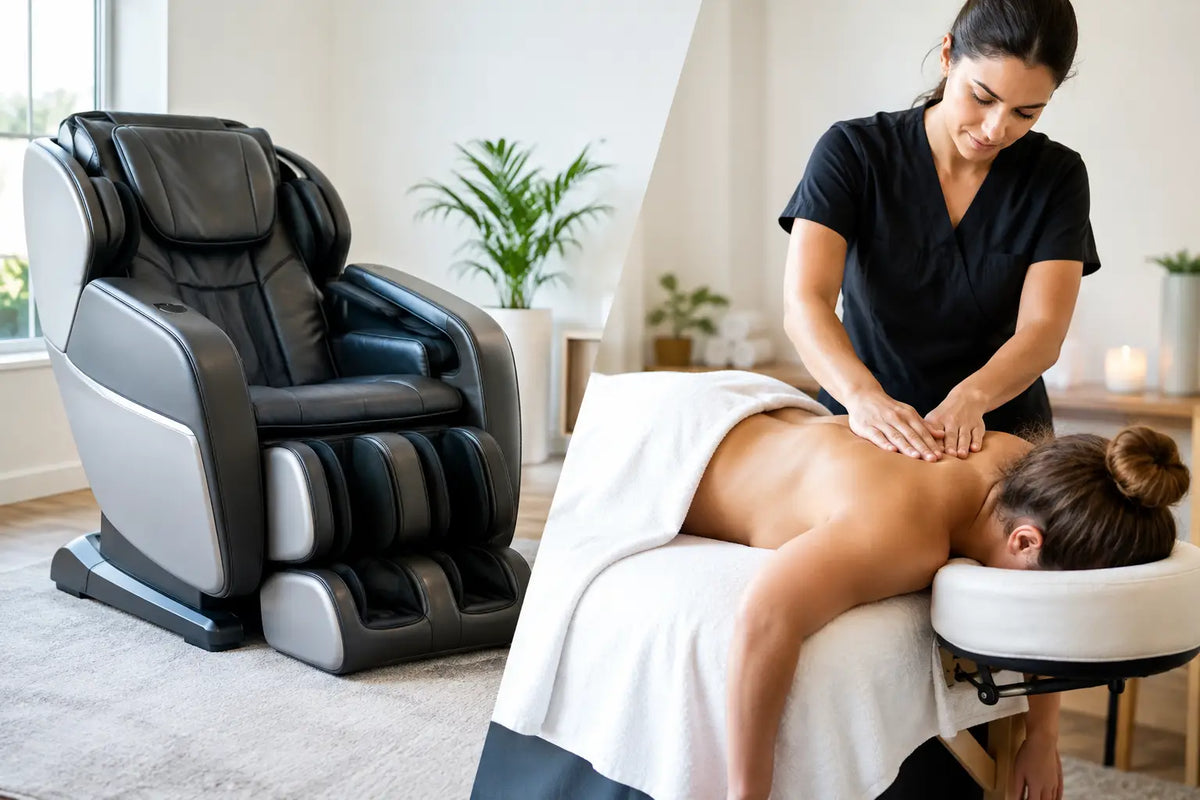
Massage Chair Versus Therapist: Which Fits You?
A late evening training session, a cross-country flight, or a calendar packed with executive decisions can leave the body asking for more than a quick stretch. The massage chair versus therapist decision is not really about whether one is universally better. It is about choosing the level of access, personalization, privacy, and professional insight that belongs in your recovery ritual.
For ambitious people, recovery must work on the days when an appointment is impossible to schedule. At the same time, there are moments when hands-on expertise and a trained set of eyes are irreplaceable. A considered wellness environment leaves room for both.
Massage Chair Versus Therapist: The Core Difference
A premium massage chair delivers repeatable, technology-led bodywork on demand. Depending on the model, it may use rollers, air compression, heat, zero-gravity positioning, body scanning, and targeted programs to address tension across the neck, shoulders, back, hips, legs, and feet. It is designed to make recovery private, immediate, and available without coordinating another person's schedule.
A licensed massage therapist offers something fundamentally different: human assessment and adaptation. They can notice asymmetry, respond to feedback in real time, vary pressure intuitively, and focus on an area that needs more attention that day. When appropriate, a therapist may also recognize when discomfort deserves evaluation by another qualified healthcare professional.
The distinction matters. A chair follows a sophisticated program. A therapist interprets the person in front of them. Neither experience has to replace the other, but each serves a different role in a high-performance lifestyle.
Where a Massage Chair Earns Its Place
The strongest case for a massage chair is consistency. Most people do not need recovery only after a major event or an exhausting week. They need it in the twenty minutes between work and dinner, after a demanding lift, or before bed when stress has settled into the upper back.
Daily access changes the recovery equation
A chair eliminates the friction that prevents good intentions from becoming habits. There is no commute, no availability issue, and no need to plan weeks ahead. You can use a short shoulder-and-neck session before a presentation, a lower-body program after cycling, or a gentle evening routine to transition out of work mode.
That frequency has real lifestyle value. While a massage chair is not a substitute for medical treatment, regular relaxation-focused sessions can support a more deliberate wind-down ritual, help you spend time off your feet, and create a dependable pause in a fast-moving day.
Privacy, control, and design matter
For many homeowners, the appeal is not only physical. A premium chair creates a private recovery destination inside the home, where strength and serenity exist in harmony. You select the timing, intensity, duration, and mood without explaining your preferences or sharing your personal space.
This is particularly compelling for executives with irregular travel schedules, athletes training outside conventional hours, and households where recovery is part of the daily standard. In a properly designed wellness suite, a massage chair can sit alongside compression therapy, heat, mobility work, and quiet restoration as a complete at-home reset.
The economics favor frequent users
A high-end chair requires a meaningful upfront investment, plus space and occasional care. Yet its value looks different when it is used five or six times a week by one person, or shared within a household. The cost is no longer tied to each session. Over time, that access can be more economical than booking frequent professional massage appointments.
The trade-off is clear: you are investing in availability and repetition, not a therapist's individual judgment. For someone who wants a reliable daily tool, that is often exactly the point.
When a Therapist Is the Better Choice
A therapist is especially valuable when your needs are complex, highly specific, or changing. Perhaps one shoulder has been restricted since a long stretch of travel. Perhaps a new training program has created a pattern of tightness your usual routine does not resolve. Perhaps you simply want the attentive, restorative experience that only expert hands can provide.
Personalization is more than pressure settings
Even the most advanced chair offers a defined set of movements and zones. A therapist can spend forty minutes on a single area, alter technique based on tissue response, and work around sensitivities that a programmed session cannot fully anticipate. They can also adapt throughout an appointment if one approach feels unproductive.
This is not an argument that harder pressure is always better. Skilled bodywork is responsive, and a qualified therapist can tailor the session to whether you want relaxation, sports-focused recovery, or a gentler experience. If you are managing an injury, unexplained pain, numbness, swelling, recent surgery, or a medical condition, seek guidance from an appropriate healthcare professional before choosing either route.
The appointment itself can be part of the benefit
A professional massage creates protected time. You arrive, disengage, and allow someone else to manage the experience. For people whose minds rarely leave work, that structure can be profoundly restorative.
A therapist may also be the better fit for an occasional deeper reset, even if you own a chair. Think of the chair as the daily foundation and hands-on care as a more tailored session when your body, training cycle, or stress load calls for it.
Cost, Time, and the Reality of Your Schedule
The practical comparison comes down to how often you will use each option. A therapist is typically paid per appointment, and rates vary substantially by location, session length, specialization, and whether the service is delivered at a spa, clinic, or home. The investment is ongoing, and appointment availability may be limited during peak hours.
A massage chair concentrates much of the investment at the beginning. It also requires adequate floor space, appropriate electrical planning, and thoughtful placement. In a luxury home, the chair should not feel like a piece of gym equipment pushed into a spare corner. It can be specified as part of a dedicated recovery room, primary-suite retreat, home gym, or executive office environment.
For commercial settings, the equation expands further. Boutique hotels, private clubs, athletic facilities, and luxury residential developments may value the chair's ability to provide a consistent self-service amenity without depending on daily therapist staffing. A well-chosen chair can elevate the guest experience while preserving privacy and operational flexibility.
The Best Answer May Be Both
For many high-performing households, this is not an either-or purchase decision. A chair handles the daily baseline: decompression after work, recovery after training, a midday reset, or a quiet pre-sleep ritual. Professional massage remains available for targeted attention and the occasional fully personalized session.
This combination avoids a common mistake: expecting one modality to solve every recovery need. Your wellness environment should be layered around how you actually live. The person who trains intensely, travels often, and carries significant professional stress may benefit from regular at-home access plus periodic hands-on care. Someone who enjoys massage primarily as an occasional indulgence may find that therapist appointments alone are enough.
How to Choose a Massage Chair With Intention
A premium massage chair delivers repeatable, technology-led bodywork on demand. Body size, preferred intensity, leg and foot treatment, heat, zero-gravity comfort, program variety, visual finish, room dimensions, and service support all deserve consideration.
A chair should feel intuitive enough to use after a long day. If controls are overly complicated or the fit feels too aggressive, it may become an expensive object rather than a daily ritual. The right model should invite use, complement the architecture of the space, and support the recovery outcomes you value most.
For a refined installation white glove service planning matters as much as the chair itself. Consider delivery access, floor protection, placement clearances, nearby power, and how the piece relates to the rest of the room. Premium recovery equipment performs best when it is treated as part of the environment, not an afterthought.
The most valuable recovery solution is the one that meets you when you need it. Whether that is a therapist's practiced hands, a chair waiting quietly at home, or a thoughtful combination of both, make the choice worthy of the standard you set for the rest of your life.
Whether the right fit is a therapist's practiced hands, a chair waiting quietly at home, or both working together, the standard you set for recovery deserves the same care as the rest of your life. Explore our Massage Chairs collection to find the model that fits your ritual, or request a quote and we'll help you build a complete recovery environment around it.