
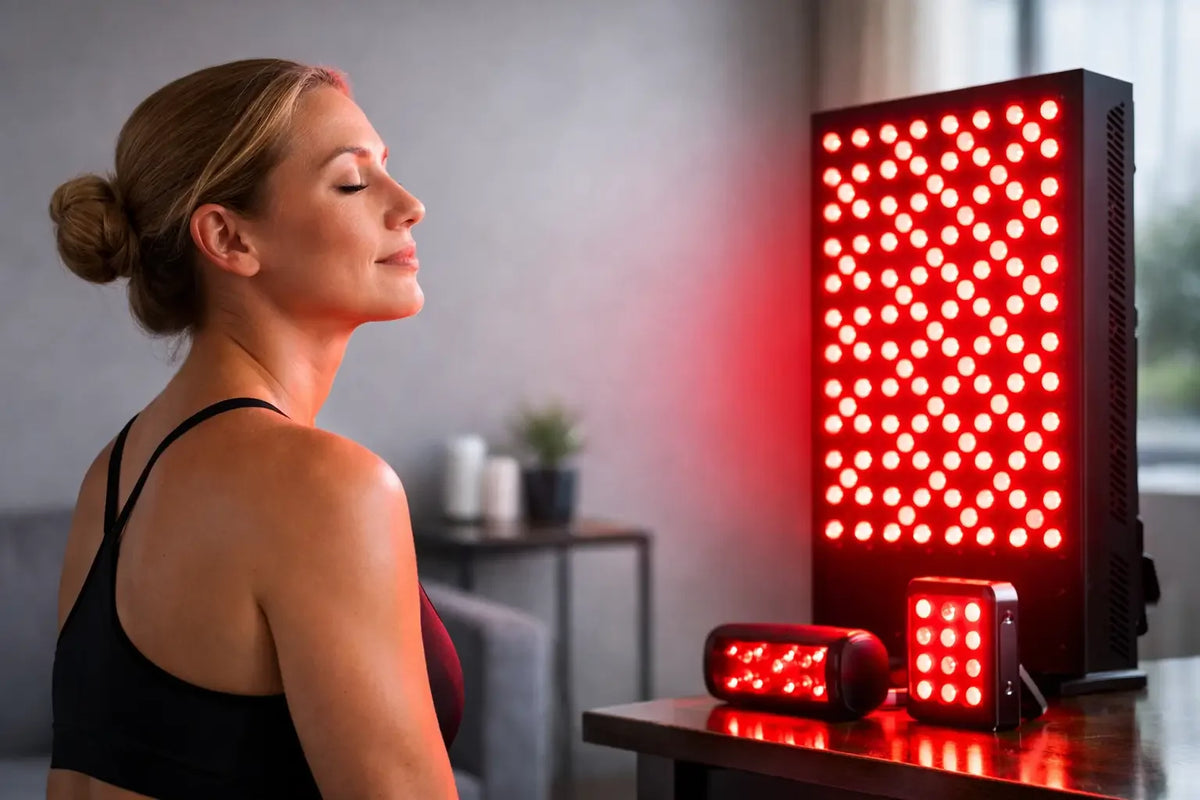
Red Light Therapy Review: Is Premium Worth It?
A red light therapy review should answer a more useful question than whether the technology is popular: will it earn a permanent place in your recovery ritual? For a high-performing household, the difference between an occasional wellness novelty and a meaningful daily modality comes down to light quality, treatment coverage, consistency, and how naturally the device fits your space.
Red and near-infrared light therapy, also called photobiomodulation uses specific wavelengths of light to support cellular processes. The appeal is clear. A short session can become a private pause between training, travel, demanding work, and sleep - without an appointment, commute, or disruption to the day. The promise is not a miracle. It is a well-designed environment that makes recovery more accessible, more consistent, and more refined.
Red Light Therapy Review: What the Evidence Supports
The strongest reason to consider red light therapy is its potential to support the body where modern schedules often create friction: recovery, skin health, and daily restoration. Red light generally works at more superficial tissue depths, which is why it is commonly used in skincare-focused protocols. Near-infrared light penetrates more deeply and is frequently chosen by athletes and active individuals seeking support for muscles and joints.
Research on photobiomodulation is encouraging in several areas, including temporary relief of minor muscle and joint discomfort, support for post-exercise recovery, and improvements in certain skin-quality measures. Outcomes, however, are not automatic. They depend on the wavelength, dose, frequency of use, treatment area, and the individual concern being addressed. A device that is exceptional for facial skin may not be the right answer for full-body soreness after a hard training block.
That distinction matters because wellness equipment is often marketed with broad, confident claims. Premium buyers should expect a more disciplined standard. Red light therapy may complement training, professional care, sleep hygiene, nutrition, and a thoughtful skincare routine. It should not be positioned as a substitute for medical evaluation, physical therapy, or treatment prescribed by a qualified clinician.
For many owners, the most tangible value is cumulative. A 10- to 20-minute session creates a repeatable moment to downshift. When the device is in a beautiful, convenient setting, consistency stops being an aspiration and becomes part of the architecture of the day.
Why Premium Equipment Feels Different
The red glow alone does not tell you much. Lower-cost devices can look compelling in a product photo while offering limited treatment area, unclear specifications, uneven light distribution, or a setup that is too inconvenient to use regularly. Premium equipment is not simply brighter. It is designed around a more complete experience.
Coverage changes the ritual
A compact panel can be an intelligent choice for a focused goal, such as the face, neck, shoulder, knee, or a localized training concern. It is also easier to place in a bedroom, home office, or apartment fitness area. The trade-off is time. Treating the front and back of the body, or several muscle groups, can require multiple positions and a longer routine.
A larger modular panel system or full-body bed changes the equation for households that value efficiency. Broader coverage can treat more of the body in a single session and makes the experience feel more like a destination ritual than another task on the calendar. For serious athletes, couples, and luxury residences with a dedicated recovery suite, that time advantage may justify the greater investment.
Specifications should be transparent
Look for manufacturers that clearly state their red and near-infrared wavelength ranges, irradiance or power density at realistic distances, treatment guidance, electrical requirements, and warranty terms. Common therapeutic ranges often include red light around 630 to 660 nanometers and near-infrared light around 810 to 850 nanometers, though the ideal configuration depends on the intended use.
More power is not automatically better. Light dosage is a balance of irradiance, time, and distance from the device. Excessive exposure does not necessarily create better results, and vague output claims make it difficult to build a sensible protocol. The premium advantage is credible engineering paired with usable guidance, not a race to the largest number on a specification sheet.
Design determines whether it gets used
A red light device should feel at home in an elevated interior. Consider the stand, mounting options, cable management, ventilation, controls, noise level, and visual finish. These details sound secondary until a large panel arrives and competes with the room rather than complementing it.
For a dedicated sanctuary, placement should be planned as carefully as a sauna or cold plunge. Allow comfortable clearance around the equipment, appropriate power access, a surface that is easy to clean, and space to stand or recline without interruption. For commercial settings, fixture location, guest flow, cleaning protocols, and staff guidance deserve the same attention as the equipment itself.
The Best Device Depends on the Goal
There is no universal winner in a credible red light therapy review. The right format follows the intended ritual.
A face mask is best suited to a skincare-centered routine and offers a compact, low-commitment entry point. Its limitation is obvious: it will not deliver meaningful full-body coverage. A targeted panel offers greater flexibility for skin, joints, and muscle groups, making it a strong choice for a personal training studio or bedroom recovery corner.
A large panel system is often the most versatile home option. It can support a full-body standing session, while still allowing targeted use at closer distances. The owner must be comfortable with a visible piece of performance equipment and should verify whether it can be safely wall-mounted or positioned on a stable stand.
A red light bed is for the client who wants full coverage, speed, and a finished hospitality-grade experience. It is especially compelling in a luxury wellness suite, private club, spa, or amenity space where a more immersive treatment justifies the footprint and budget. Installation planning, freight coordination, electrical needs, and service access are part of the decision, not afterthoughts.
A Practical Protocol Without the Guesswork
Consistency matters more than marathon sessions. Start with the manufacturer’s recommended distance and session length, then give the routine several weeks before judging it. Three to five sessions per week is a common cadence for many home users, but the correct schedule should follow the device instructions and your response.
For skin-focused sessions, clean skin is generally the simplest approach. For post-training use, many people schedule red light therapy after exercise as part of a larger wind-down sequence that may include compression, hydration, mobility work, or heat therapy. The best timing is the one you will repeat.
Use eye protection when the manufacturer directs it, particularly with powerful panels. People with photosensitivity, those using medications that increase sensitivity to light, and anyone managing an eye condition or active medical concern should speak with a clinician before beginning. Pregnancy, a history of cancer, and unexplained pain are also reasons to seek individualized medical guidance rather than self-prescribing a protocol.
Track outcomes that matter to you. That may be how your skin looks and feels, perceived soreness after training, range of motion, or how reliably you complete your evening recovery routine. A few notes over eight to 12 weeks are more revealing than judging a device after two sessions.
The Investment Test
A premium red light device earns its place when it removes obstacles. If a focused panel makes you more likely to address a recurring shoulder issue or maintain a skin ritual, its smaller footprint may be exactly right. If your household already prioritizes daily training, contrast therapy, or restorative sleep, full-body coverage may offer the more coherent return on time.
Budget should include more than the purchase price. Consider delivery, assembly, dedicated electrical needs, wall reinforcement or floor space, warranty coverage, and the service experience if equipment needs attention. For residential and commercial projects, a curated partner such as Luxe Vida Wellness can help align the equipment format with the room, aesthetic, and operational demands before delivery day.
The best red light therapy setup is not necessarily the largest one. It is the one you can use confidently, frequently, and comfortably enough that recovery becomes a standard of your environment rather than another item on your to-do list.
Talk to a Luxe Vida Wellness specialist to find the red light setup that fits your space and your ritual.